 By
By Plenty of newcomers in their first year barely earn anything, owe no tax, and take one look at the T1 form and decide filing isn't worth it. It's an expensive assumption. There's a saying that captures it perfectly: filing is how the government finds out it owes you money. For low- and modest-income residents, one of the things a tax return quietly switches on is the GST/HST credit — a quarterly, tax-free deposit (it shows up labelled "Canada FPT" in your banking app) that you get simply because you filed.
If you're new to Canada and your income is modest, this is some of the easiest money you'll ever claim. And 2026 is a strange, important year for it: there's a one-time bonus payment going out right now (June 2026), and in July the credit gets renamed, raised by 25%, and reborn as the Canada Groceries and Essentials Benefit (CGEB). Here's the whole picture.
Quick Answer: How Do New Immigrants Apply for the GST/HST Credit?
A new immigrant or newcomer applies for the GST/HST credit by filing one form in their arrival year: Form RC151 if you have no children, or Form RC66 (with RC66SCH) if you have kids. After that first year, you simply file a T1 tax return every spring — even on $0 income — and the credit renews automatically. It's a tax-free quarterly payment that gives low- and modest-income residents back some of the sales tax they pay.
For July 2025 to June 2026, the credit is worth up to $519/year for a single person, $680 for a couple, plus $179 per child under 19, paid in January, April, July, and October. There is no separate application after your first form — ever. The CRA recalculates your amount automatically each July from your latest tax return.
And mark July 2026: the credit becomes the Canada Groceries and Essentials Benefit, with amounts going up 25%. You don't need to do anything to switch over — same eligibility, same quarterly schedule, bigger deposit.
The 2026 Shake-Up: Top-Up Now, CGEB in July
Two changes are happening as I write this, and both are good news.
1. A one-time top-up is being paid out right now. Starting June 5, 2026, the CRA is sending everyone who was entitled to the January 2026 GST/HST credit payment a bonus equal to 50% of their annual credit. A single person on a $25,000 income gets about $260; a family of four on $40,000 gets about $519. It arrives the same way as your regular payments — if you got the January one, watch your account.
2. From July 2026, the credit becomes the CGEB — 25% larger. Same income test, same quarterly dates, same "just file your taxes" mechanics. The federal government has committed to the increased amount from 2026 through 2031. Your bank statement label will change; nothing about how you qualify does.
If you only remember one thing from this section: there is no new application for any of this. People who file tax returns get it. People who don't, don't.
Summary: June 2026 brings a one-time bonus worth half your annual credit; July 2026 renames the credit to CGEB and raises it 25% — both automatic if you've been filing.
How the GST/HST Credit Actually Works
In BC you pay 5% GST plus 7% PST on most non-grocery purchases — that $30 ramen night on Robson costs $31.50 (restaurant meals are GST only, no PST). The GST/HST credit exists because sales tax hits lower incomes hardest: everyone pays the same 12% (5% GST plus 7% PST) on a winter jacket, whether they earn $20,000 or $200,000. The credit hands part of it back.
The 2025-26 amounts
| Household | Maximum per year |
|---|---|
| Single adult | $519 |
| Married / common-law couple | $680 |
| Each child under 19 | $179 |
A single parent with one child can also claim the child as an "eligible dependant," which in practice pushes their total close to a couple's amount plus the per-child amount.
The credit starts shrinking once adjusted family net income passes $44,324 (2024 base year), at a rate of 5 cents per dollar above the line; only the income at which it reaches $0 varies by family size. Your amount for July 2025 through June 2026 is set by your 2024 return; the CGEB payments starting July 2026 will be set by your 2025 return.
What happened to the BC Climate Action Tax Credit?
Older guides (including the original version of this article) will tell you BC adds a Climate Action Tax Credit to the same quarterly deposit. That program is gone. BC cancelled its consumer carbon tax on April 1, 2025, and the final BCCATC payment went out on April 4, 2025. If you're owed money for earlier benefit years, you can still get it retroactively by filing those old returns — but no new BCCATC is coming. The quarterly deposit you see going forward is federal only.
Summary: Up to $519 single / $680 couple / $179 per child, paid quarterly, set by last year's tax return — and the old BC top-up no longer exists, whatever older blog posts say.
RC151 vs RC66: Which Form Do Newcomers Use?
In your arrival year you don't have a Canadian tax return yet, so you apply with a one-time form instead. Which form depends on one thing: whether you have children.
| Your situation | Form to file | Full name |
|---|---|---|
| Newcomer, no children | RC151 | GST/HST Credit and Canada Carbon Rebate Application for Individuals Who Become Residents of Canada |
| Newcomer, with children under 19 | RC66 + RC66SCH | Canada Child Benefits Application + Status in Canada and Income Information |
If you have children and you (or your spouse/common-law partner) meet the Canada Child Benefit eligibility rules, file Form RC66, Canada Child Benefits Application, together with Form RC66SCH. The CRA uses that same RC66 information to set up your GST/HST credit — you don't file RC151 as well. If you have no children, or you have children but don't qualify for the CCB, file Form RC151 instead.
A couple of points that trip newcomers up:
- There is no "RC66-1" or "RC66 1" form. People search that, but the actual companion to RC66 is RC66SCH ("SCH" for schedule). If a guide tells you to file "RC66-1," it means RC66SCH.
- CGEB is not a form you file. CGEB is the Canada Groceries and Essentials Benefit — the new name the GST/HST credit takes on July 3, 2026. There's no CGEB application: the same RC151 or RC66 you file now carries straight over.
Either way, this is a one-time step. After your arrival year, the credit (and CGEB after it) flows from your annual T1 — so the next thing to get right is filing your first tax return as a newcomer.
Summary: No kids → RC151. Kids + CCB-eligible → RC66 + RC66SCH (not "RC66-1"). CGEB is the credit's July 2026 name, not a separate form.
Step-by-Step: Claiming the Credit as a New Immigrant in Vancouver
Step 1: File Form RC151 in your arrival year
The credit normally flows from a tax return — but in your first year, you don't have one yet. Form RC151, "GST/HST Credit and Canada Carbon Rebate Application for Individuals Who Become Residents of Canada," bridges that gap (or RC66 + RC66SCH if you have children — see the form comparison above). Fill it in (it asks for your arrival date and your income for the part of the year before you came), and mail it to your tax centre. You can also now apply online through the CRA's newcomer benefit application; mailing the paper form to your tax centre remains an option.
A lot of newcomers never hear about RC151 and skip it. The system usually catches up after your first tax return with a retroactive lump sum, so the money isn't lost — but you can end up waiting a year for payments that could have started within two quarters of landing.
Step 2: File your first T1 return the following spring
Your first tax return — due April 30 — reports your worldwide income from your date of arrival onward, plus (for benefit calculations only) what you earned before arriving. Once it's assessed, every federal benefit you qualify for switches on by itself: this credit, and if you have kids, the Canada Child Benefit too.
Step 3: File free — software or a human
- Software: Wealthsimple Tax is pay-what-you-want and handles newcomer first returns fine. NETFILE submission means assessment in about two weeks.
- A human, for free: CVITP community tax clinics run March-April across Metro Vancouver — the central Vancouver Public Library at 350 West Georgia hosts them, and immigrant-serving agencies like MOSAIC and SUCCESS run clinics with volunteers who speak Mandarin, Cantonese, Punjabi, and more. Income limits apply (around $35,000 for a single person), which most first-year newcomers fall under. Our guide to free tax clinics in Vancouver for newcomers lists where to go.
Never pay a "benefits consultant" to apply for this credit. There is nothing to apply for beyond the return itself.
Step 4: Get your details right
Three fields cause almost all the problems:
- Marital status — in Canada, living together 12+ months makes you common-law, and the CRA means it. Misreporting this is the top cause of clawbacks.
- SIN — both spouses need one and both file.
- Address — update the CRA every time you move. Newcomers move a lot; cheques and CRA mail don't forward themselves.
Step 5: Set up direct deposit, then leave it alone
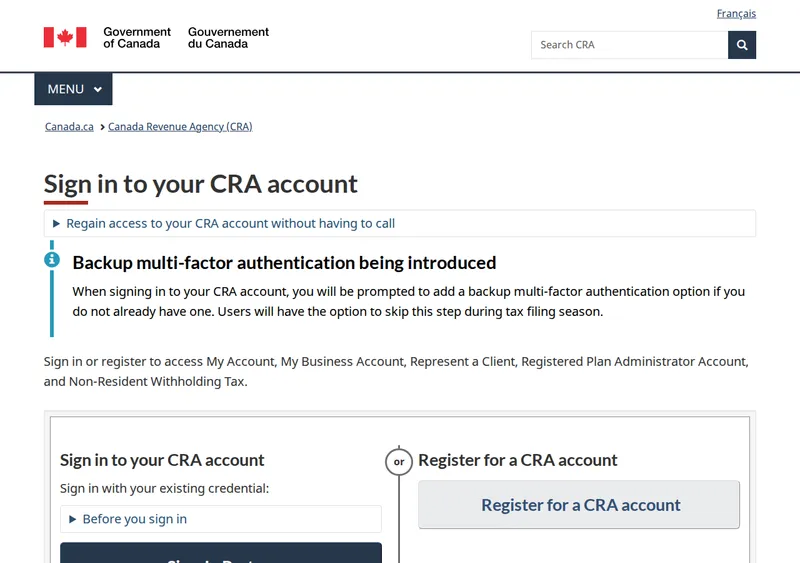
Register for CRA My Account, add your bank details, and the quarterly payments handle themselves. Expect up to 8 weeks of processing after your return is assessed, with your first payment on the next quarterly date (the 5th of January, April, July, October, give or take a business day). After that, the only maintenance is filing every spring.
If the quarterly deposits aren't money you need same-month, a high-interest account for your credit payments — like EQ Bank — at least makes them earn something while they sit.
Summary: RC151 on arrival, a T1 every spring, direct deposit once — then the CRA does the rest, including the upgrade to CGEB.
GST/HST Credit Payment Dates 2026
The credit pays out quarterly, on the 5th of January, April, July, and October — and if the 5th lands on a weekend or federal holiday, the CRA pays on the last business day before it. Here's how 2026 breaks down, including the mid-year switch to the CGEB:
| Quarter | Payment date | Paid as |
|---|---|---|
| Q1 2026 | January 5, 2026 | GST/HST credit |
| Q2 2026 | April 2, 2026 | GST/HST credit |
| One-time top-up | June 5, 2026 | 50% of annual credit (bonus) |
| Q3 2026 | July 3, 2026 | Canada Groceries & Essentials Benefit (CGEB) |
| Q4 2026 | October 5, 2026 | CGEB |
The January and April 2026 deposits go out under the GST/HST credit's old name. From July 3, 2026 the same payment continues as the Canada Groceries and Essentials Benefit, 25% larger — same quarterly rhythm, same eligibility, no action needed on your end.
Summary: Five 2026 dates — Jan 5 and April 2 as the GST/HST credit, a one-time top-up on June 5, then July 3 and October 5 as the larger CGEB.
Common Mistakes Newcomers Make
1. Not filing because income was low or zero
The mistake: "I made nothing, so there's nothing to file." The cost: Every benefit tied to the return — this credit, the CCB, provincial programs — stays off. For a couple, that's $680/year minimum, rising 25% under CGEB. The fix: File anyway. A nil return is the key that opens everything.
2. Skipping Form RC151 in the arrival year
The mistake: Waiting for the first tax return to start benefits. The cost: Up to a year of payments delayed (recoverable retroactively, but why wait). The fix: Mail RC151 within your first couple of months in Canada.
3. Getting marital status wrong
The mistake: Reporting "single" while living common-law, because that's how it worked back home. The cost: The CRA recalculates as a couple later and demands the overpayment back. The fix: 12 months of living together = common-law on every CRA form, full stop.
4. Leaving pre-arrival income off the return
The mistake: Reporting only Canadian income in your arrival year. The cost: Benefits get calculated wrong, then corrected, then clawed back. The fix: Report worldwide income for the pre-arrival portion of the year — it isn't taxed, it just calibrates your benefits.
5. Paying someone to "apply" for you
The mistake: Handing $50-$200 to a service that promises to "unlock government benefits." The cost: The fee, for something the CRA does automatically. The fix: A free CVITP clinic or pay-what-you-want software does the identical thing.
Summary: Every mistake on this list is some version of "didn't file" or "filed with wrong details" — the credit itself has no failure modes beyond that.
Frequently Asked Questions
Can new immigrants apply for the GST/HST credit?
Yes. New immigrants and newcomers can apply from their arrival year — you don't have to wait for a tax return. File Form RC151 if you have no children, or Form RC66 + RC66SCH if you do, and the credit (renamed the CGEB from July 3, 2026) starts flowing. After that first form, just file a T1 every spring and it renews automatically.
Can international students get the GST/HST credit?
Yes. If you're in Canada long enough to be a resident for tax purposes — living here through the school year, with a bank account, a lease, a part-time job — you qualify like anyone else. File RC151 when you arrive and a return each spring. For a student on a near-zero income, that's the full $519/year (more once CGEB starts), for ten minutes of paperwork.
How long after filing does the first payment arrive?
Up to 8 weeks for the CRA to process your return or RC151, then your money arrives on the next quarterly date — the 5th of January, April, July, or October. File in March, and your first payment is usually the July one.
Do I need to apply again every year?
No. One RC151 when you arrive, then a tax return every spring. The CRA recalculates each July with no action from you — including the switch to CGEB in July 2026.
Will I get the June 2026 one-time top-up?
If you were entitled to the January 2026 quarterly payment, yes — it's 50% of your annual credit, paid automatically starting June 5, 2026. If you weren't getting the credit in January (say, you arrived recently and haven't filed yet), the top-up passes you by, which is one more reason to get RC151 in early.
My income went up this year. Do I owe anything back?
No. Each benefit year is locked to the prior year's return. Higher income this year means a smaller credit starting next July — never a repayment of what you already received, as long as your reported details were accurate.
I've been in Canada three years and never filed. Is the money gone?
No — file the missed returns now and the CRA pays the back benefits as lump sums. Filing your missed returns automatically recovers up to 3 years of back GST/HST credit. Going back further (to a 10-year limit) requires a separate taxpayer-relief request and isn't automatic.
Is the credit (or the CGEB) taxable?
No. It never appears as income on any return. Same for the June top-up and the CCB.
References
- GST/HST credit: how much you can get — Canada.ca — official 2025-26 amounts
- Canada Groceries and Essentials Benefit — Canada.ca — the program replacing the credit in July 2026
- One-time GST/HST credit top-up payment — Canada.ca — June 5, 2026 payment details
- Form RC151 — Canada.ca — the newcomer application for your arrival year
- How to get the credit (RC151 vs RC66 for newcomers) — Canada.ca — which form to file with or without children
- GST/HST credit payment dates — Canada.ca — official quarterly schedule
- Free tax clinics (CVITP) — Canada.ca — find a free clinic near you
Filing your first return also unlocks the Canada Child Benefit if you have kids — and once the deposits start, here's where to put the money.