 By
By When I moved to Vancouver in 2025 on a work permit, RRSP and TFSA were just confusing acronyms I kept seeing on bank websites. My first priorities were the practical ones — getting a SIN, opening a bank account, finding somewhere to live in Richmond — and every explainer I found about these accounts seemed to assume a lifetime of Canadian financial history I simply didn't have.
It wasn't until my first tax season that it finally clicked: these accounts are tools for real-life goals, not abstract retirement concepts. Used right, they're one of the few genuine advantages the Canadian system hands a newcomer — if you understand the rules that apply specifically to you.
For newcomers, understanding the RRSP (Registered Retirement Savings Plan) and TFSA (Tax-Free Savings Account) is about more than just investing. It's about building financial security in your new home, whether you're saving for a security deposit on an apartment in Burnaby, planning for a family visit back home, or eventually buying a car to explore the Sea-to-Sky Highway. The rules are different for you, especially around contribution room, and choosing the wrong account first can cost you money in unnecessary taxes or missed opportunities.
This guide cuts through the complexity. I'll explain these accounts in plain English, share exactly what I wish I'd known (including my own early mistakes), and give you a clear, step-by-step action plan tailored to the Vancouver context.
Quick Answer: RRSP or TFSA First for Newcomers in 2026?
For most newcomers in their first few years in Canada, open a TFSA first.
This is especially true if your annual income is below $60,000. The TFSA lets your savings grow completely tax-free, and you can withdraw the money anytime for any reason without penalty — perfect for uncertain early years when you might need funds for emergencies, moving costs, or setting up your home. Your RRSP contribution room is based on Canadian income you haven't earned yet, and using it when you're in a lower tax bracket often provides less benefit. I opened my own TFSA at CIBC in my first year here, and prioritising it over an RRSP was the single best financial move I made as a newcomer — the flexibility mattered far more than a tax deduction I couldn't yet use.
If you land a high-paying job quickly (think $80,000+ annual salary), then contributing to an RRSP first might make sense. The tax refund you get can be a significant cash boost to help with settling in. However, you need to have earned that income in Canada and filed a tax return to even get the RRSP room. For the vast majority, the flexibility and immediate utility of the TFSA wins.
How RRSPs and TFSAs Actually Work in Canada
When I first heard "registered account," I imagined something official and restrictive, like a government-monitored vault. In reality, both RRSPs and TFSAs are labels you can put on investment or savings accounts at a bank or brokerage. This label gives them special tax rules. Let's break down each one.
What is a TFSA? Your Flexible, Tax-Free Savings Tool
A Tax-Free Savings Account (TFSA) is exactly what it sounds like: any money you put in, any investment growth (interest, dividends, capital gains) that happens inside it, and any money you take out is completely tax-free. It was introduced in 2009, and every Canadian resident aged 18 or older gets new contribution room each year.
The key for newcomers: your room starts accumulating from the year you become a resident of Canada, not from when you turned 18. If you arrived in July 2024, you'd get the full 2024 TFSA room ($7,000) plus the 2025 and 2026 amounts as those years pass.
The beauty of the TFSA is its flexibility. You can withdraw funds at any time for any reason, and the amount you withdraw is added back to your contribution room at the start of the next calendar year. This makes it ideal for short to medium-term goals. You can treat it like a supercharged savings account: instead of leaving an emergency fund in a regular high-interest savings account where the interest is taxed, keep it in a high-interest TFSA savings account — for example at an online bank like EQ Bank — so the interest grows tax-free and you can still access it instantly when money is tight.
What is an RRSP? A Tax-Deferral Strategy for Your Peak Earning Years
A Registered Retirement Savings Plan (RRSP) is designed specifically for retirement. Its core mechanic is a trade-off with the Canada Revenue Agency (CRA). You get a tax deduction today for the money you contribute (within your limit), which can lead to a nice tax refund. In exchange, you agree to pay tax later when you withdraw the money in retirement. The idea is that you'll be in a lower tax bracket when you're retired and not earning a salary, so you pay less tax overall.
Your RRSP contribution room is calculated as 18% of your "earned income" from the previous year in Canada, up to an annual maximum ($33,810 for 2026). This is a critical difference for newcomers: if you didn't work in Canada last year, your RRSP contribution room is $0. You only start generating room after you file your first Canadian tax return showing employment or business income.
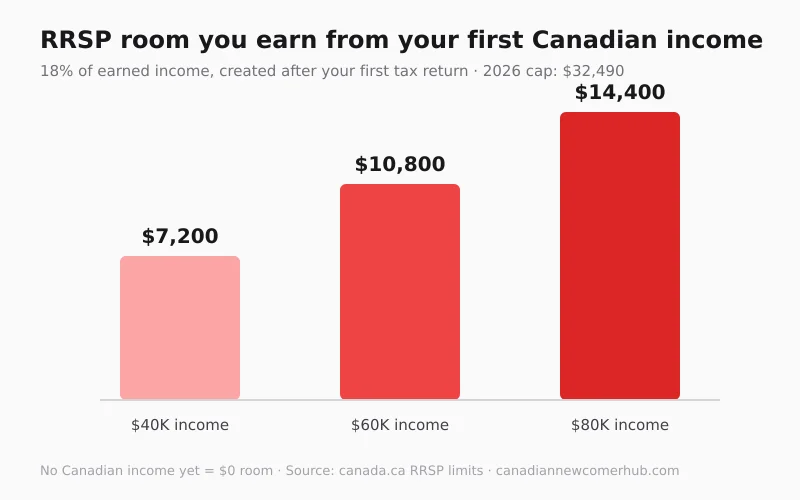
This is why rushing to open an RRSP as soon as you get your SIN is often pointless — and it's a genuinely common newcomer mistake. People contribute a small amount before they have any room, then have to fill out extra paperwork (and risk a penalty) to undo it. The bank won't stop you, because they aren't required to check your individual contribution room — that's on you.
The Core Difference: Tax Now vs. Tax Later
The simplest way to remember the difference is the timing of the tax bill.
- TFSA: Contributions are made with after-tax money. You've already paid income tax on that cash. Once it's in the TFSA, the CRA doesn't touch it again.
- RRSP: Contributions are made with pre-tax money. You get to deduct the contribution from your taxable income now, lowering your current tax bill. The government's share of that money stays in the account and grows, but they will collect tax on the entire amount (your original contribution plus all growth) when you withdraw it decades later.
Summary: A TFSA is funded with after-tax money for tax-free growth and withdrawals — ideal for any goal. An RRSP uses pre-tax money for a current tax deduction, with withdrawals taxed as income in retirement. For newcomers without prior Canadian income, TFSA room is available immediately, while RRSP room must be earned. Most newcomers should prioritize the TFSA for its flexibility and immediate accessibility.
RRSP vs TFSA Comparison: Which is Best for Newcomers in 2026?
Choosing between an RRSP and a TFSA isn't about which account is objectively better. It's about which one is better for your specific situation right now. Here is a detailed comparison table, followed by clear guidance on who should pick which.
| Feature | TFSA | RRSP | Best For Newcomers? |
|---|---|---|---|
| Tax on contribution | After-tax income. No deduction. | Tax-deductible. Reduces taxable income. | TFSA. You likely need every take-home dollar to settle in. |
| Tax on growth | 100% tax-free. | Tax-deferred until withdrawal. | Tie. Both shield growth from annual taxes. |
| Tax on withdrawal | Completely tax-free. | Taxed as regular income that year. | TFSA. Tax-free access matters in unpredictable early years. |
| 2026 contribution limit | $7,000 annual. Unused room carries forward. | 18% of last year's earned income, up to $33,810. Unused room carries forward. | TFSA. Full $7,000 room as a new resident. RRSP room starts at $0. |
| Withdrawal rules | Any amount, anytime, for any reason. Added back to room next calendar year. | Withholding tax (10–30%) at source. May lose contribution room permanently. | TFSA. No penalties, no tax, no complex rules. |
| Primary purpose | Flexible savings for any goal (emergency, car, home, travel, retirement). | Retirement. Also First Home Buyers' Plan (HBP) and Lifelong Learning Plan (LLP). | TFSA. Your first financial goals are rarely "retirement." |
| Impact on benefits | Withdrawals don't affect income-tested benefits (GST/HST credit, OAS). | Withdrawals are income, can reduce income-tested benefits in retirement. | TFSA. Protects current and future benefit eligibility. |
When to Choose a TFSA First (The Newcomer Default)
You should open a TFSA first if:
- Your Canadian income is under $60,000.
- You've been in Canada for less than 2-3 years.
- You have short-term savings goals (1-5 years) like building an emergency fund, saving for a car, or traveling home.
- You value simple, penalty-free access to your money.
This covers most newcomers. The TFSA is your financial workhorse. You can start with a simple high-interest savings TFSA at an online bank like EQ Bank or Tangerine, and later, as you learn more, use the same TFSA to hold low-cost investment ETFs through a platform like Wealthsimple or Questrade (see our Wealthsimple vs Questrade comparison).
When to Consider an RRSP First (The Exception)
Consider prioritizing RRSP contributions if:
- You immediately enter a high-income job (e.g. over $80,000 salary in BC).
- You expect your income to be higher now than in retirement (a safe assumption for most young professionals).
- You have already generated RRSP room by filing a Canadian tax return.
The immediate tax refund can be powerful. A $5,000 RRSP contribution for someone in the BC 28.2% tax bracket (income ~$100K) could generate a ~$1,400 refund. That's a meaningful sum that could pay for a professional certification course or several months of groceries.
However, don't contribute to an RRSP just to get a refund if you'll need that money soon — withdrawing it is cumbersome and taxable.
Summary: If your income is below $60,000, start with a TFSA. If above $80,000, consider the RRSP for the tax refund. Between $60-80K, split contributions or prioritize TFSA for flexibility. Always check your official contribution room via the CRA My Account portal before contributing.
Step-by-Step Guide to Opening an Account in Vancouver
Theory is great, but action is what builds your financial future. Here is the exact process I followed and refined. This assumes you have your Social Insurance Number (SIN) and a local bank account already.
Step 1: Determine Your Contribution Room
This is the most important step newcomers skip. Never assume your room.
- TFSA room: Calculate it based on your year of residency. The CRA lists annual limits. If you became a resident in 2024 or later, your total room is the sum of limits from your arrival year onward.
- RRSP room: Check your latest Notice of Assessment (NOA) from the CRA after filing your first Canadian tax return. It will state your "RRSP deduction limit." If you haven't filed yet, your room is likely $0.
Step 2: Choose a Financial Institution
You have two main paths: a traditional bank or a low-cost online brokerage.
- Traditional banks (CIBC, RBC, TD, etc.) — good for in-person help. However, investment fees (MERs) are higher, and they may push their own products.
- Online-only banks & brokerages — my recommended starting point for TFSAs:
- Wealthsimple — user-friendly, free trading for Canadian stocks/ETFs, great educational content.
- Questrade — excellent for buying ETFs free.
- EQ Bank — great TFSA savings account rates.
You can open all three entirely online from your apartment in Kitsilano, Surrey, or anywhere else in BC.
Step 3: Gather Documents and Apply
You'll typically need:
- Your Social Insurance Number (SIN).
- A primary photo ID (Passport, PR Card).
- A secondary ID (BC Driver's Licence, BC Services Card).
- Your Canadian bank account details for funding.
The online application for a place like Wealthsimple takes about 15 minutes. For in-person, book an appointment at a bank branch to avoid long waits.
Step 4: Fund Your Account and Choose Investments
This is where people freeze. Start simple.
- TFSA starter strategy: Open a TFSA high-interest savings account at EQ Bank (for a cash emergency fund) or open a TFSA with Wealthsimple Trade and buy a single, diversified ETF like VGRO or XEQT. Set up a small automatic monthly contribution, even $50 or $100. This builds the habit.
- RRSP starter strategy: If going the RRSP route, consider a robo-advisor like Wealthsimple Invest. You answer a risk questionnaire, and they automatically build and manage a diversified ETF portfolio for you for a modest fee (around 0.5%).
Step 5: Monitor and Adjust Annually
Once a year, ideally after you receive your NOA from the CRA:
- Re-check your contribution rooms.
- Re-assess your income and goals.
- Adjust your contributions accordingly.
Summary: Open a TFSA first at a low-cost platform like Wealthsimple. Determine your contribution room, apply online with your SIN and ID, and start by funding a simple ETF or savings account. Review your strategy annually when you file your taxes. The hardest part is starting — so take the first step this week.
Common RRSP and TFSA Mistakes Newcomers Make
We all make financial mistakes, especially in a new system. Here are the costly errors I've seen (and made myself), complete with the real dollar amounts they can waste.
1. Overcontributing to Your TFSA
The mistake: Assuming your TFSA room is the total of all annual limits since 2009 (when the program started). If you arrived in 2024, your room is not $95,000+. It's $7,000 (2024) + $7,000 (2025) + $7,000 (2026) = $21,000.
The cost: The CRA charges a penalty tax of 1% per month on the excess amount until you withdraw it. If you over-contributed by $10,000, that's a $100 penalty every single month.
The fix: Always calculate your room based on your year of residency. Keep your own records until the CRA's My Account shows your official limit.
2. Contributing to an RRSP With No Room
The mistake: Walking into a bank, getting excited about a tax refund, and putting money into an RRSP before you've filed a Canadian tax return and earned contribution room.
The cost: Similar to a TFSA overcontribution — a 1% monthly penalty on the excess. You also miss out on the tax deduction you thought you were getting. You've locked money away with no benefit.
The fix: Do not open an RRSP until you have a Notice of Assessment from the CRA stating your "RRSP Deduction Limit." Focus on your TFSA in year one.
3. Using a TFSA as a Daily Trading Account
The mistake: Treating your TFSA like a day-trading account, constantly buying and selling stocks. While allowed, the CRA may consider this "carrying on a business" inside the account.
The cost: All your trading profits could be taxed at 100% as business income, negating the entire tax-free benefit. You could also have your contribution privileges revoked.
The fix: Use your TFSA for long-term investing and savings, not frequent, speculative trading. Use a regular (non-registered) account for active trading if you must.
4. Withdrawing from an RRSP for a Short-Term Need
The mistake: Treating an RRSP like a savings account and withdrawing $5,000 to cover a rental deposit or a trip.
The cost: Immediate withholding tax (10% for amounts under $5,000, 20% up to $15,000) — that's $500 to $1,000 gone instantly. Plus, the withdrawal is added to your annual income and taxed again at your marginal rate at tax time. You also lose that contribution room forever.
The fix: For short-term needs, use your TFSA or a regular savings account. Only use RRSP withdrawals for retirement or through formal programs like the Home Buyers' Plan (HBP).
5. Not Investing the Money Inside the Account
The mistake: Opening a TFSA or RRSP and just letting the cash sit in a savings portion earning 0.1% interest, thinking that's the "safe" option.
The cost: Loss of growth to inflation. At 2% inflation, $10,000 loses $200 of purchasing power in a year. In a low-interest account, you're effectively losing money.
The fix: Once you have a 3-6 month emergency fund in a safe place, invest your long-term TFSA/RRSP contributions in a diversified portfolio of low-cost ETFs to aim for growth that outpaces inflation. This is as important as choosing the right account itself.
Summary: Key mistakes include overcontributing, using RRSPs for short-term cash, and not investing within the accounts. These errors can cost hundreds in penalties and thousands in lost growth. Always verify your contribution room with the CRA and align the account's purpose with your actual time horizon and goals.
Frequently Asked Questions
I am an international student. Can I open a TFSA or RRSP?
Yes, you can open a TFSA if you are 18 or older and have a valid Social Insurance Number (SIN). However, you must be a resident of Canada for tax purposes. Most international students are considered residents if they have significant residential ties (lease, bank account, driver's license). Your contribution room starts from the year you establish residency. For RRSPs, you need earned income in Canada to generate room, which is less common for students. Always consult the CRA's guidelines on residency status or a tax professional.
What happens to my TFSA if I leave Canada?
You can keep your TFSA open and the investments inside it continue to grow tax-free. However, you will not accumulate new TFSA contribution room for any year you are a non-resident of Canada. You can still manage your existing account, but any new contributions made while a non-resident will be subject to a 1% monthly penalty tax. It's often best to stop contributing if you leave permanently.
Can I use my RRSP to buy my first home in Canada?
Yes, through the Home Buyers' Plan (HBP). Since the 2024 federal budget, you can withdraw up to $60,000 (per person) from your RRSP tax-free to buy or build a qualifying home — for a couple, that's $120,000 combined. You must be a first-time home buyer and a resident of Canada. The key is you must repay the withdrawn amount back into your RRSP over 15 years; for withdrawals made through 2025, repayments don't begin until the fifth year after you take the money out. If you miss a repayment, that amount is added to your taxable income for that year. Newcomers saving for a first home should also look at the First Home Savings Account (FHSA), which combines a tax deduction (like an RRSP) with tax-free withdrawals (like a TFSA) — often the better first stop before tapping an RRSP.
Which is better for saving for a child's education, an RRSP or TFSA?
For a child's education, neither is typically the best first choice. The Registered Education Savings Plan (RESP) is specifically designed for this, as it offers government grants (the Canada Education Savings Grant) that can boost your savings by 20% or more. However, if you have maximized your RESP contributions, a TFSA is an excellent supplementary tool due to its flexibility. An RRSP is generally not ideal for this shorter-term goal due to taxable withdrawals.
I have old RRSPs from a previous work stint in Canada. What should I do?
First, locate your old account statements and find your RRSP "deduction limit" from your last Notice of Assessment. This room is still yours. You can reactivate or transfer the old account to a new institution like Wealthsimple for easier management. Be aware of any transfer fees your old bank may charge. It's a good idea to consolidate old accounts to simplify your financial picture.
Can I hold US stocks or ETFs in my TFSA or RRSP?
Yes, you can. However, there's an important tax nuance for US dividends. In an RRSP, US dividends are exempt from the 15% US withholding tax due to a tax treaty. In a TFSA or regular (non-registered) account, that 15% tax is withheld on dividends before you receive them — but in a non-registered account you can generally recover it by claiming the foreign tax credit on your return, whereas in a TFSA it is a permanent loss with no way to claim it back. So the TFSA is at the biggest disadvantage for US dividends. For long-term holdings of US dividend-paying stocks, the RRSP can be slightly more tax-efficient. For growth stocks that pay little or no dividends, the TFSA is fine.
How do I actually check my TFSA and RRSP contribution room?
The most reliable method is through the CRA's My Account portal. You need to register. Your room is updated based on the tax returns and information slips (T4s, T5s) that the CRA has processed, so there can be a lag. Your financial institution does not know your personal contribution room across all accounts — that's your responsibility to track. Keep your own records from the day you become a resident.
References
- Canada Revenue Agency, "Canadian Income Tax Rates for Individuals," 2025. Federal and provincial tax brackets for the current tax year.
- Financial Consumer Agency of Canada, "Choosing a Bank Account," 2025. Guide to opening and comparing Canadian bank accounts.
- Immigration, Refugees and Citizenship Canada, "Your First Few Days in Canada," 2025. Official settlement checklist for new permanent residents.