 By
By Most newcomer parents land with the same question: "How are we going to afford daycare here?" And almost none of them realise the answer often starts with a benefit they can claim within months of arriving — one many don't believe is real at first. The government just... sends money? Every month? Even though we just got here?
For a family with two young children and a modest income, the Canada Child Benefit can work out to more than $1,300 a month, tax-free.
The CCB is the single largest piece of financial support most newcomer families will ever receive in Canada, and it's also one of the most commonly missed — because nobody tells you that you might qualify even on a work permit, or that you have to file a tax return (even one showing $0 income) to start the payments. This guide covers how much you'd get in 2026, the BC top-up most articles skip, and the exact forms newcomer families need to file.
Quick Answer: How Much Is the CCB and Who Gets It in 2026?
The Canada Child Benefit is a tax-free monthly payment of up to $7,997 per year per child under 6, and up to $6,748 per year per child aged 6 to 17, for the July 2025–June 2026 year. Newcomers qualify: permanent residents right away, and work or study permit holders after living in Canada 18 consecutive months. Both parents must file a tax return to receive it.
You get the full amount if your adjusted family net income (AFNI) is under $37,487. Above that, payments shrink gradually — many families earning $80,000+ still receive hundreds per month.
BC families get a second payment on top: the BC Family Benefit adds up to $1,750/year for your first child, $1,100 for the second, and $900 for each additional child.
The two catches for newcomers: both spouses must file a Canadian tax return (even with zero income), and temporary residents — work permit or study permit holders — qualify only after living in Canada for 18 consecutive months, starting from month 19. Permanent residents, protected persons, and citizens qualify right away.
How the Canada Child Benefit Actually Works
Think of the CCB like a sliding-scale subsidy that the Canada Revenue Agency (CRA) recalculates once a year using your tax return — the same way your rent at a co-op might be set as a share of your income. File your taxes, and the money follows. Skip filing, and the money stops, no matter how eligible you are.
Can newcomers get the CCB? (eligibility)
Yes — and this is the part most newcomer parents get wrong. Here is the rule, stated plainly:
Newcomers can get the Canada Child Benefit. Permanent residents, protected persons, and citizens qualify as soon as they arrive. Temporary residents on a work permit or study permit qualify after they have lived in Canada for 18 consecutive months and hold a valid permit in the 19th month.
You can get the CCB if all of these are true:
- You live with a child under 18 and you're the one mainly responsible for their care
- You're a resident of Canada for tax purposes
- You or your spouse/common-law partner is one of: a Canadian citizen, a permanent resident, a protected person, or a temporary resident who has lived in Canada for the previous 18 months with a valid permit in the 19th month
- Both you and your spouse/common-law partner have filed a Canadian tax return — even one showing $0 income (this is what unlocks the GST/HST credit at the same time)
That third bullet is the one newcomer parents misread. A work permit doesn't disqualify you — it just adds a waiting period. For example, a family that arrived in March 2025 on a work permit would hit the 18-month mark in September 2026, and could apply that October.
Maximum CCB amount per child (2025-26)
The maximum Canada Child Benefit is $7,997 per year ($666.41/month) for each child under 6, and $6,748 per year ($562.33/month) for each child aged 6 to 17.
| Child's age | Maximum per year | Maximum per month | Full amount if AFNI below |
|---|---|---|---|
| Under 6 | $7,997 | $666.41 | $37,487 |
| 6 to 17 | $6,748 | $562.33 | $37,487 |
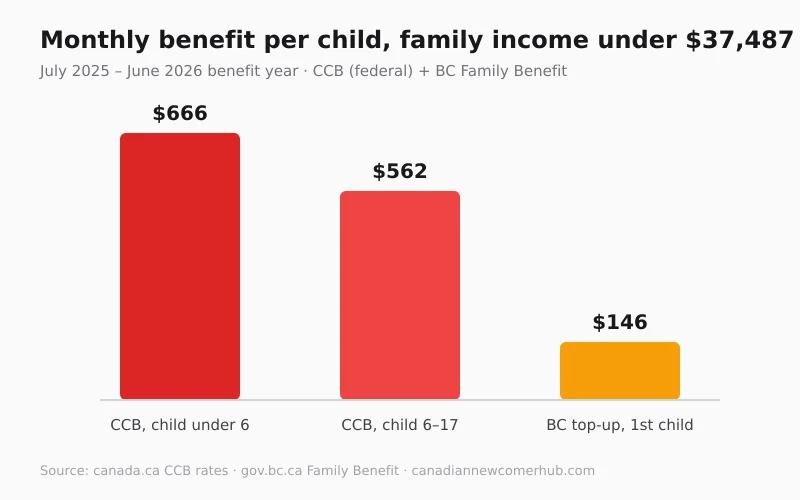
Above $37,487, the benefit phases out at 7% of the income over the line for one child, 13.5% for two, and 19% for three.
A worked example, since the formula looks scarier than it is. Family with two kids under 6, AFNI of $50,000:
- Maximum: 2 × $7,997 = $15,994
- Income over the line: $50,000 − $37,487 = $12,513
- Reduction: 13.5% × $12,513 = $1,689
- Annual CCB: $15,994 − $1,689 = $14,305, or about $1,192/month
Tax-free. It doesn't count as income on next year's return, and it doesn't reduce any other benefit.
The annual reset every July
Each July, the CRA recalculates your CCB using the previous year's tax return. The payments you get from July 2026 onward will be based on your 2025 return — which for many newcomers is the first full year of Canadian income. If your income was low in your arrival year, your first benefit year is often your biggest.
Summary: Up to $7,997 per young child, recalculated every July from your tax return — and a work permit only delays eligibility 18 months, it doesn't remove it.
The BC Family Benefit: The Top-Up Most Newcomers Miss
If you live in BC, filing the same tax return also triggers the BC Family Benefit — no separate application. For July 2025 to June 2026:
| Child | Maximum per year |
|---|---|
| First child | $1,750 |
| Second child | $1,100 |
| Each additional child | $900 |
Families with AFNI under $29,526 get the full amount. Between $29,526 and $94,483 the amounts step down but don't disappear, and above $94,483 they shrink by 4% of the income over that line. It arrives in the same monthly deposit as the CCB, around the 20th of each month, labelled "Canada Child Benefit" in your banking app — which is why a lot of people never realize the BC portion exists.
Summary: BC quietly adds up to $1,750 per child on top of the federal CCB; one tax return covers both.
Step-by-Step: Applying for the CCB as a Newcomer in Vancouver
This is the order that works, with the places newcomer families in Vancouver actually go.
Step 1: Get SINs for both parents — same week you arrive
Both spouses need a Social Insurance Number before anything else works. In downtown Vancouver, the Service Canada office at 757 West Hastings Street handles walk-ins; bring passports and your permits or COPR. The SIN is issued on the spot.
Step 2: Both spouses file a tax return — even with $0 income
The CRA calculates the CCB from family net income, so it needs a return from each spouse. This trips up single-income families constantly: if only the working spouse files, the application sits in limbo. A $0-income return takes ten minutes with Wealthsimple Tax, or free in person at a CVITP tax clinic — MOSAIC and SUCCESS both run them, and SUCCESS has Mandarin- and Cantonese-speaking volunteers at its Chinatown office.
In your arrival year, you also report income earned before you came to Canada. It isn't taxed here, but the CRA uses it to set your benefit amounts for the months after you arrived.
Step 3: File Form RC66 — plus the schedule nobody mentions
The application itself is Form RC66, Canada Child Benefits Application. Newcomers also need Form RC66SCH (Status in Canada and Income Information) — this is the part most generic guides skip, and missing it is the #1 reason newcomer applications stall. If your child was born outside Canada, attach proof of birth (passport or birth certificate copy).
Mail both to the Winnipeg Tax Centre, or upload them through CRA My Account if you've registered.
If your baby is born in BC, skip all of this: the hospital's Newborn Registration Service lets you tick one box that registers the birth, applies for the SIN, and applies for the CCB in one go.
Step 4: Set up CRA My Account and direct deposit
Register at canada.ca for CRA My Account, then add direct deposit. Cheques to a newcomer's address have a way of arriving after you've moved out of your first short-term rental. Your first deposit is often backdated — payments are paid retroactively to the month after you became eligible, so an approval that takes a couple of months usually arrives as a lump sum covering the wait.
Step 5: Wait, then check — processing takes up to 3 months
Newcomer applications (the paper RC66 route) take longer than online ones — budget 8 to 11 weeks. Track the status in My Account. Once approved, payments land monthly around the 20th.
Step 6: Keep it flowing — file every April, report changes
No reapplying. File your taxes every spring (deadline April 30), and the CCB recalculates each July on its own. Report marital status changes and custody changes to the CRA when they happen, not at tax time — overpayments get clawed back with no sympathy.
If the deposits start stacking up, the simplest first move is to grow your CCB in a high-interest account so it earns something between expenses. From there, a Registered Education Savings Plan (RESP) is the natural next stop — the government adds a 20% grant on contributions, which I cover in my RRSP vs TFSA guide for newcomers alongside the other registered accounts.
Summary: SIN → both spouses file taxes → RC66 + RC66SCH → direct deposit → payments around the 20th, backdated to when you became eligible.
Common Mistakes Newcomer Families Make
1. Not filing taxes because "we had no income"
The mistake: Waiting until you have a Canadian job to file your first return. The cost: $666/month per young child, delayed for every month you wait. The fix: File a $0 return for both spouses your first spring in Canada, no exceptions.
2. Only one spouse files
The mistake: The non-working spouse skips their return. The cost: The CRA can't calculate family income, so it pays nothing — the application just stalls. The fix: Two spouses, two returns, every year.
3. Assuming a work permit means "not eligible"
The mistake: Temporary residents never apply at all. The cost: For a family with two young kids, walking away from roughly $16,000/year once the 18-month mark passes. The fix: Mark month 19 on your calendar and apply that week.
4. Skipping Form RC66SCH
The mistake: Sending RC66 alone, because the CRA's page doesn't shout about the schedule. The cost: Weeks of extra processing while the CRA mails you a request for the missing form. The fix: Newcomers file RC66 + RC66SCH together, with proof of birth for kids born abroad.
5. Reporting a separation or new partner late
The mistake: Telling the CRA about a marital status change at tax time instead of when it happened. The cost: Months of overpayment the CRA will demand back, sometimes with interest. The fix: Update marital status in My Account the month it changes.
Summary: Almost every CCB problem traces back to one missing tax return or one missing form — both are fixable in an afternoon.
Frequently Asked Questions
Can I get the CCB on a work permit or study permit?
Yes, after you've lived in Canada for 18 consecutive months and you hold a valid permit in your 19th month. From that point you apply like anyone else. Months you spent in Canada before getting your current permit can count, as long as you were living here legally and continuously.
Is the CCB taxable? Does it affect my other benefits or my PR application?
No on all counts. The CCB is tax-free, doesn't count as income anywhere on your return, and is a tax benefit — not social assistance — so receiving it has no bearing on permanent residence applications or sponsorship undertakings.
My child was born in Canada but my spouse and I are temporary residents. Does the 18-month rule still apply?
The 18-month residency requirement applies to the parents, not the child. Your Canadian-born child's citizenship doesn't shortcut the waiting period — you still apply once you (or your spouse) hit month 19 with a valid permit.
How far back will the CRA pay retroactively?
Payments are backdated to the month after you became eligible, as long as you apply within a reasonable window. If you're applying for a period more than 11 months back, the CRA will ask for supporting documents (proof of residence, proof the child lived with you), but it can and does pay multiple years of missed benefits.
What happens in shared custody?
If a child lives with each parent between 40% and 60% of the time, the CRA splits the CCB 50/50. Each parent's half is calculated from their own family income, so the two halves are often different amounts.
My income went up after I applied. Do I have to pay anything back?
No. The CCB always looks backward: each July-to-June benefit year is set by last year's return. A raise this year shrinks next July's recalculation, but money already paid based on a past return stays yours.
We're moving from BC to another province. Do we lose the benefit?
The federal CCB follows you anywhere in Canada. The BC Family Benefit stops, and whatever your new province offers (Ontario Child Benefit, Alberta Child and Family Benefit, etc.) starts after you update your address with the CRA.
References
- Canada child benefit: how much you can get — Canada.ca — official 2025-26 amounts and AFNI thresholds
- Canada Child Benefit guide (T4114) — Canada.ca — eligibility rules, including the 18-month temporary resident provision and forms RC66/RC66SCH
- BC Family Benefit — Province of British Columbia — provincial amounts and income thresholds
- Child and family benefits calculator — Canada.ca — estimate your exact payment before applying
Also worth reading: how the GST/HST credit works for newcomers — the other benefit your first tax return unlocks automatically.