 By
By If you've settled in Canada and want your mom, dad, or grandparents to come and actually live with you for a while — not just visit for a few weeks — the Super Visa is almost certainly the route you want. It's quietly one of the most generous temporary-resident options Canada offers, and most newcomers don't realise it exists until someone older in the family starts asking when they can come.
The catch is that one requirement trips up more applicants than all the others combined: the mandatory medical insurance. Get that part wrong and the application is refused, full stop. This guide walks through the whole thing — what the Super Visa is, who qualifies, the income rule for the host, and exactly what the insurance has to cover — with every figure checked against the official IRCC pages (linked at the bottom).
Quick Answer: What Is the Super Visa?
The Super Visa is a multi-entry temporary resident visa for the parents and grandparents of Canadian citizens and permanent residents. It is valid for up to 10 years, and — since July 2022 — it lets the holder stay in Canada for up to 5 years at a time per entry. To get it, the visiting parent/grandparent must buy at least $100,000 CAD of Canadian-approved medical insurance valid for one year, the host in Canada must meet a minimum income level, and the applicant must pass an immigration medical exam.
That 5-year stay is the headline feature. A regular visitor visa typically lets someone stay 6 months at a time; the Super Visa is built for long, continuous family visits — helping with grandchildren, recovering after retirement, or simply being close to family without going through full permanent-residence sponsorship.
Summary: Super Visa = up to 10 years validity, up to 5 years per stay, multi-entry. The three pillars are: a qualifying host, a qualifying relationship, and a year of approved $100,000+ medical insurance.
Who Is Eligible
The Super Visa has requirements on two people: the applicant (the parent or grandparent abroad) and the host (the family member in Canada).
The applicant must:
- Be the parent or grandparent of a Canadian citizen or permanent resident. Dependants of the parent/grandparent generally can't be included on the same application — siblings and other relatives don't qualify.
- Be applying from outside Canada (or be eligible to apply, depending on their situation).
- Have a signed invitation letter from their child or grandchild in Canada (more on this below).
- Have valid medical insurance that meets IRCC's requirements (covered in detail in its own section).
- Pass an immigration medical exam.
- Be otherwise admissible — no serious criminality, and an officer must be satisfied they'll leave Canada at the end of their authorised stay.
The host in Canada must:
- Be a Canadian citizen or permanent resident (temporary residents and study/work permit holders can't host a Super Visa).
- Meet the minimum income requirement for their family size (next section).
- Sign the invitation letter promising to financially support the parent/grandparent during the visit.
Summary: The relationship has to be parent or grandparent — no aunts, uncles, or in-laws. The host has to be a citizen or PR with enough income. If you're still on a work permit yourself, you can't host yet. If you're working toward PR, our Express Entry guide and work permit guide are good places to understand where you stand.
The Host's Income Requirement
This is where most families do their math. The host has to show they earn at least the minimum necessary income for their household size — a figure IRCC publishes each year, based on Canada's Low Income Cut-Off (LICO). For Super Visa purposes this threshold has historically been calculated as LICO plus 30%, which is why the numbers are higher than the bare LICO you might see elsewhere.
Here are the income amounts in effect for 2026 applications. Always confirm your own family-size figure on the official IRCC income page (linked in References), because these adjust annually:
| Family size | Minimum income (2026) |
|---|---|
| 1 person | $30,526 |
| 2 persons | $38,002 |
| 3 persons | $46,720 |
| 4 persons | $56,724 |
| 5 persons | $64,336 |
| 6 persons | $72,560 |
| 7+ persons | $80,784 (add $8,224 per extra person) |
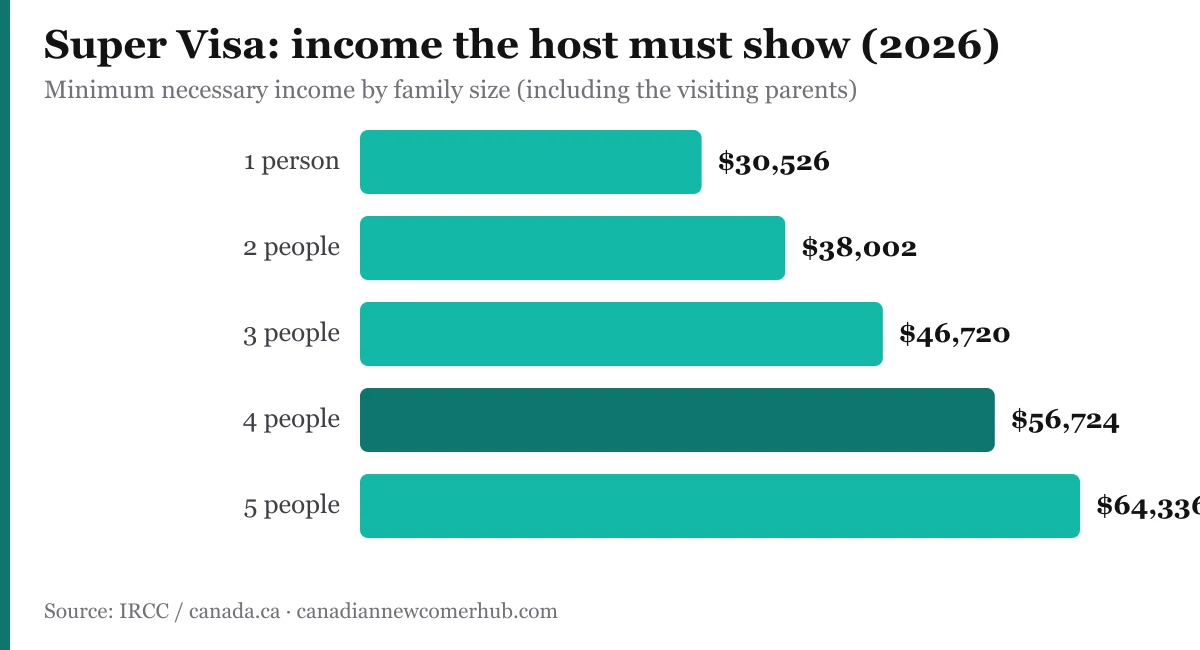
Counting your family size correctly matters. It includes the host, their spouse or partner, their dependent children, and the parents/grandparents being invited — plus anyone the host has previously sponsored and is still responsible for. So a couple with two kids inviting both parents is a family of six ($72,560), not two.
Two new flexibilities you should know (effective March 31, 2026)
IRCC made the income test more forgiving in 2026 in two ways that genuinely help borderline families:
- Two-year lookback. Instead of only the single most recent tax year, you can now qualify using your income from either of the two most recent tax years. A good year in 2024 can rescue a weaker 2025.
- Combined income. The visiting parent or grandparent's own income (pension, retirement savings, investment income) can now be added to the host's income to reach the threshold. This recognises that many incoming seniors are financially self-sufficient.
You prove income with documents like your Notice of Assessment from the CRA, T4s, pay stubs, or an employment letter. If you haven't filed a Canadian tax return yet, that's your first job — see our first-time tax filing guide (linked in References too).
Summary: Match your family size to the table, then prove you hit that income in one of the last two tax years — and if you're short, the visiting parent's pension income can count toward the total now.
The Mandatory Medical Insurance — Don't Skip This
This is the single most important section, because a missing or non-compliant policy is the most common reason Super Visa applications fail. Canada doesn't want a visiting senior to have a medical emergency and end up with a hospital bill no one can pay — so the insurance rules are strict and non-negotiable.
The policy your parent or grandparent buys must:
- Provide at least $100,000 CAD in coverage.
- Be valid for a minimum of one year from the day they plan to enter Canada.
- Cover healthcare, hospitalization, and repatriation (repatriation = the cost of returning the person to their home country, including in the event of death).
- Be paid in full (or have proof of a payment plan) at the time of application — and proof of the paid policy submitted with the application.
Canadian or foreign insurer?
For years, the policy had to come from a Canadian insurance company. That changed: as of January 28, 2025, IRCC also accepts policies from approved insurers outside Canada — specifically, foreign insurers authorised by Canada's Office of the Superintendent of Financial Institutions (OSFI). This was meant to widen the market and bring prices down, but most families still buy from a Canadian provider because the claims process is smoother.
What to look for when shopping (the practical angle)
Premiums vary enormously — typically a few hundred to a few thousand dollars a year — driven mostly by the applicant's age and any pre-existing conditions. When comparing quotes, check:
- Pre-existing condition coverage and the "stability period." Many policies cover pre-existing conditions only if they've been stable for a set window (often 90–180 days) before coverage starts. For older applicants this clause is the whole ballgame — read it carefully.
- Deductible. A higher deductible lowers the premium but means more out-of-pocket at claim time.
- Monthly-payment options. Several insurers now let you pay monthly instead of one large annual lump sum. This is a real cash-flow help — but make sure IRCC will accept proof of the instalment plan (you generally need the policy to still represent a full year of coverage).
- Refund policy if the visa is refused. Choose a provider that refunds the premium (minus a small fee) if the application is denied. Not all do.
A note for the longer term: the Super Visa insurance covers your parent as a visitor. It is not the same as provincial health coverage. If your parent eventually becomes a permanent resident, they'd then look at provincial plans — in British Columbia, that's MSP, which we cover in our BC health insurance guide for newcomers.
Summary: $100,000 minimum, one full year, covers care + hospital + repatriation, fully paid with proof. The make-or-break detail for older applicants is the pre-existing-condition stability clause — compare that line before you compare price.
How to Apply, Fees, and Processing
The Super Visa is applied for online through IRCC, usually as a visitor-visa application where you indicate you're applying for the Super Visa. The typical package includes:
- The completed application and the host's invitation letter (stating the relationship, the host's promise of financial support, household details, and the purpose/length of the visit).
- Proof of the host's citizenship/PR status and income (Notice of Assessment, T4, pay stubs, employment letter).
- Proof of the relationship (birth certificates linking applicant → host).
- Proof of the medical insurance policy.
- Results of the immigration medical exam.
Fees (per person, 2026): the visitor-visa application fee is $100, plus an $85 biometrics fee. On top of that you'll pay for the medical exam (set by the panel physician, varies by country) and the insurance premium itself.
Processing time varies a lot by the country you apply from — it can run from roughly a couple of months to six-plus months — and it does not include the time to give biometrics. Check the live processing-time tool on IRCC's website for the current estimate from your specific country before you plan travel.
Once approved, the parent/grandparent can enter and leave Canada multiple times over the validity of the visa, staying up to five years each visit. When your parents arrive and start settling in, our first-week-in-Canada checklist is a handy orientation, even for a long visit.
Summary: Apply online, attach the invitation letter + income proof + insurance + medical exam, pay ~$100 + $85 biometrics, and check the country-specific processing estimate before booking anything.
Frequently Asked Questions
Can someone on a work permit or study permit host a Super Visa?
No. The host must be a Canadian citizen or permanent resident. If you're still on a temporary status, you'll need to get PR first before you can host your parents on a Super Visa.
How long can my parents actually stay?
Up to 5 years per entry, and the visa itself can be valid for up to 10 years (or until the passport expires, whichever comes first). They can request an extension once here, and they can come and go multiple times.
Do my parents need insurance for the whole 5 years up front?
The application requires proof of at least one year of coverage. To keep staying legally beyond that, they need to maintain valid medical insurance for the duration of each visit — so plan to renew it.
Is the Super Visa the same as sponsoring my parents for permanent residence?
No. The Super Visa is a long-stay visitor status — your parents remain temporary residents and don't get PR, a health card, or work rights through it. It's separate from (and far faster than) the Parents and Grandparents PR sponsorship program.
My income is just below the threshold. Am I out of luck?
Maybe not. As of March 31, 2026 you can qualify using either of your two most recent tax years, and you can add the visiting parent's own income (pensions, savings) to yours. Check both before assuming you don't qualify.
Can my parents work or claim benefits while on a Super Visa?
No. They're visitors — no work authorisation, and they don't qualify for benefits like the Canada Child Benefit or provincial health coverage. (Those are for residents — see our Canada Child Benefit guide for who actually qualifies.)
References
- Super visa for parents and grandparents — Government of Canada (IRCC)
- Super visa: Income requirements — Government of Canada (IRCC)
- Change to health insurance requirement makes the super visa more accessible — IRCC notice
- Biometrics and fees — Government of Canada (IRCC)
- Check processing times — Government of Canada (IRCC)
This guide is for general information and reflects IRCC rules as of June 2026. Immigration rules change — always confirm the current figures, fees, and requirements on the official Government of Canada pages above before applying.