 By
By Metro Vancouver is the most expensive rental market in Canada, but the price you pay depends heavily on which side of the region you live on. A one-bedroom that costs $2,226 in the City of Vancouver can be found for roughly $1,700 in Surrey — a difference of roughly $6,300 a year for the same number of bedrooms. For a newcomer landing without a credit history or a local reference, choosing the right municipality is one of the biggest levers you have on your monthly budget.
This guide consolidates current 2026 rent data across the Metro Vancouver region — Vancouver, Surrey, Burnaby, Coquitlam, New Westminster, Richmond and beyond — so you can see where rent is genuinely cheaper and what you trade off to get there. All dollar figures below are area-level averages drawn from published 2026 rent reports, not individual listings. Real listings vary widely by building age, unit size and exact location.
Quick Answer: Which Metro Vancouver areas are cheapest to rent in 2026?
In 2026, Surrey is consistently the cheapest part of Metro Vancouver to rent, with an unfurnished one-bedroom averaging around $1,700/month, according to liv.rent's May 2026 Metro Vancouver Rent Report. New Westminster follows in the low $1,900s, and Coquitlam and Richmond sit around $2,000–$2,100. Burnaby is mid-pack at roughly $2,100, while the City of Vancouver is the most expensive of the major hubs at about $2,226 for a one-bedroom.
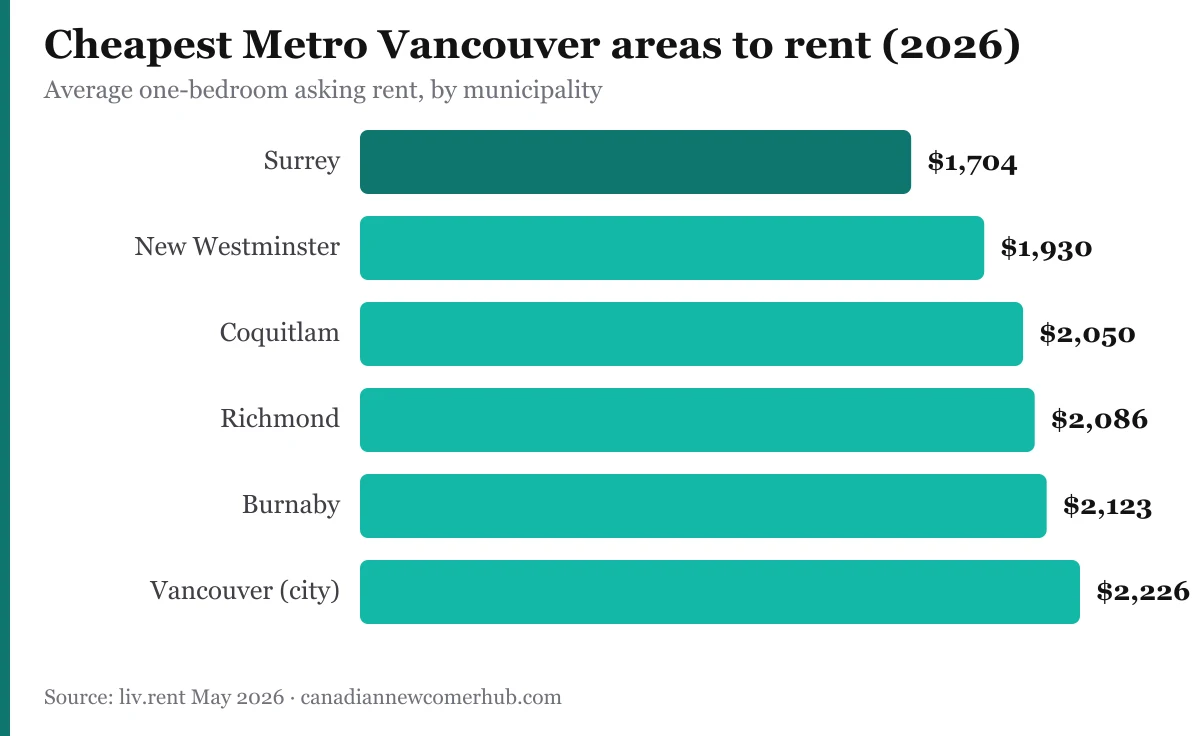
Rough 2026 one-bedroom price bands across the region:
- Most affordable (~$1,700–$1,950): Surrey, New Westminster, Langley
- Mid-range (~$2,000–$2,150): Coquitlam, Richmond, Burnaby
- Most expensive (~$2,350+): City of Vancouver (downtown, West Side, Kitsilano running well above the city average)
For context, the region-wide average for a newly listed unfurnished one-bedroom was $2,086/month in May 2026 — and Metro Vancouver rents have been falling year-over-year for over two years, sitting roughly 14% below their September 2023 peak.
The more affordable areas
Surrey — the cheapest in Metro Vancouver
Surrey is the clear value leader. An unfurnished one-bedroom averaged about $1,704 in May 2026, and earlier in the year (January 2026) it sat around $1,724 — the lowest of any major Metro Vancouver municipality in every monthly report this year. Within Surrey, Surrey City Centre is the most affordable sub-area (around $1,706 for a one-bedroom in May 2026), while South Surrey runs higher (closer to $1,829).
The trade-off: distance and commute. Surrey is the southeastern corner of the region. The good news for newcomers is the SkyTrain Expo Line, which runs from Surrey City Centre and King George through Surrey-Newton straight into downtown Vancouver. If you live near a SkyTrain station, the rent savings are real and the commute is manageable; if you're car-dependent in outer Surrey, factor in driving time and bridge traffic.
New Westminster — central and still under $2,000
New Westminster is one of the best-kept secrets for affordability that's still close to the centre of the region. One-bedroom rents averaged roughly $1,868 in March 2026 and around $1,930 in May 2026 — comfortably below the regional average. New West is a small, dense, walkable city with multiple Expo Line SkyTrain stations (Columbia, New Westminster, Sapperton) and a quick ride to both Burnaby and downtown.
The trade-off: older housing stock in parts of the city, and the more affordable units are often in older walk-up buildings rather than new towers. Newer waterfront developments command higher rents.
Coquitlam — the Evergreen Line commuter pick
Coquitlam one-bedrooms sit around $2,050–$2,100 in 2026 — affordable for its location, especially measured by price per square foot (about $2.80/sq ft in early 2026, among the lowest in the region). The Millennium Line's Evergreen extension connects Coquitlam Central, Lincoln and Lafarge Lake–Douglas to Burnaby and onward toward Vancouver.
The trade-off: commute length. Even with SkyTrain, you're a fair distance from downtown Vancouver, so this works best if your job is in the northeast sector or you don't commute downtown daily.
Richmond — south of the city, on the Canada Line
Richmond one-bedrooms run around $2,000–$2,100 in 2026 and the city offers some of the better rent-per-square-foot value in the region (roughly $2.68/sq ft in May 2026). It sits on the Canada Line, giving a fast, direct ride to downtown Vancouver and direct access to YVR airport — a genuine advantage if you fly often.
The trade-off: Richmond is built on a flood plain, is mostly flat and car-oriented outside the Canada Line corridor, and some newcomers find it less walkable away from the central Brighouse/Aberdeen area.
Burnaby — mid-priced, very central
Burnaby is the geographic centre of the region and a reasonable middle ground. An unfurnished one-bedroom averaged about $2,123 in May 2026 — above the cheaper suburbs but below the City of Vancouver. Burnaby is exceptionally well served by transit, with both the Expo and Millennium Lines crossing it (Metrotown, Brentwood, Lougheed, Edmonds), making car-free living realistic.
The trade-off: you pay for that central location and transit access. Burnaby is more expensive per square foot than Surrey, Richmond or Coquitlam, and the newer tower districts (Metrotown, Brentwood) push rents higher.
Parts of East Vancouver
If you want to stay inside the City of Vancouver but spend less, East Vancouver neighbourhoods (toward Renfrew, Collingwood and Killarney along the Expo Line) generally rent below the West Side and downtown. You won't match Surrey prices, but you can land below the city's $2,226 average while keeping a true Vancouver address and short transit times.
The expensive cores
The priciest rents concentrate in the City of Vancouver, where the one-bedroom average was about $2,226 in 2026, and within it:
- Downtown / Coal Harbour / Yaletown — premium for walkability and waterfront
- West Side / Kitsilano / Point Grey — established, leafy, expensive
- The North Shore (North Vancouver) — among the highest rent-per-square-foot in the region (around $3.69/sq ft). West Vancouver has high absolute rents but unusually large units, so its rent per square foot is actually among the region's lowest.
These areas buy you proximity, beaches, walkability and prestige — not value. For a newcomer focused on stretching the first year's budget, they're rarely the right starting point.
2026 rent comparison table
Approximate average unfurnished one-bedroom rents across Metro Vancouver in 2026. Treat these as area-level midpoints, not quotes — see References for sources and dates.
| Area | Approx. 1BR average (2026) | SkyTrain access | Relative affordability |
|---|---|---|---|
| Surrey | ~$1,700 | Expo Line | Cheapest |
| New Westminster | ~$1,870–$1,930 | Expo Line | Very affordable |
| Coquitlam | ~$2,050–$2,100 | Millennium / Evergreen | Affordable |
| Richmond | ~$2,000–$2,100 | Canada Line | Affordable |
| Burnaby | ~$2,123 | Expo + Millennium | Mid-range |
| East Vancouver | Below city avg | Expo Line | Mid-range (in-city) |
| City of Vancouver (overall) | ~$2,226 | All lines | Expensive |
| Downtown / West Side / Kitsilano | Above city avg | All lines | Most expensive |
| Metro Vancouver region average | ~$2,086 | — | — |
Studios typically run a few hundred dollars below the one-bedroom figure in each area, but studio supply is thin in the suburbs, so the gap and availability vary.
The newcomer angle: what you're really trading off
Rent vs. commute is the core trade. The cheaper municipalities (Surrey, Coquitlam) are also the farthest from the downtown job core. Before signing, map your likely workplace or school against the SkyTrain network. A one-bedroom that saves you $600/month but adds 90 minutes of daily commuting may not be the bargain it looks like — but if your job is in Surrey, Burnaby or remote, that saving is pure upside.
Stay near SkyTrain. For a newcomer who may not have a car yet, living within walking distance of an Expo, Millennium or Canada Line station is the single biggest quality-of-life decision. It turns a "far" suburb into a 30–40 minute reliable ride and removes the need to budget for a car, insurance (ICBC) and parking. See our Vancouver transit and Compass Card guide to understand how the fare zones work.
Budget the whole picture, not just rent. Cheaper rent is one line in a larger budget. Factor in transit passes, utilities and the upfront move-in cash before you commit — and because available plans and speeds differ across the region, it's worth taking a moment to compare internet by neighborhood once you've shortlisted an area. Our Vancouver cost-of-living guide for newcomers and move-in costs checklist break down what the first month actually costs.
Good listings move fast — and scams target newcomers. In affordable pockets near transit, well-priced units can be gone within a day or two. Be ready to view quickly and have your documents in order, but never wire a deposit before seeing a unit and signing a real tenancy agreement. Read our guide on how to find a Vancouver apartment without getting scammed before you start, and know your protections under BC tenant rights.
Frequently Asked Questions
What is the cheapest city to rent in Metro Vancouver in 2026?
Surrey is the cheapest major municipality, with an unfurnished one-bedroom averaging around $1,700/month in 2026 — consistently the lowest in every monthly Metro Vancouver rent report this year. New Westminster is the next most affordable, in the low $1,900s.
How much cheaper is the suburbs than downtown Vancouver?
Roughly $500 or more per month for a one-bedroom. The City of Vancouver averages about $2,226 while Surrey averages about $1,704 — a difference of around $520/month, or roughly $6,300 a year, for the same unit type.
Are Metro Vancouver rents going up or down in 2026?
Down. The region's average newly listed unfurnished one-bedroom was about $2,086 in May 2026, and rents have fallen year-over-year for more than two years — roughly 14% below the September 2023 peak. That said, individual neighbourhoods and renewals can still move differently, and well-priced units rent fast.
Can I live in a cheaper suburb without a car?
Yes, if you stay near SkyTrain. Surrey and New Westminster are on the Expo Line, Coquitlam on the Millennium/Evergreen extension, and Richmond on the Canada Line. Living within walking distance of a station makes a car-free commute into Vancouver realistic and removes the cost of a vehicle and ICBC insurance.
Is Burnaby a good middle-ground option?
Yes. Burnaby averages about $2,123 for a one-bedroom — more than Surrey or Richmond but less than the City of Vancouver — and it's exceptionally well connected, with both the Expo and Millennium Lines. It's a strong pick if you want central location and transit without paying full Vancouver prices.
Do these rent figures include utilities and furniture?
No. The averages cited here are for unfurnished units and generally do not include utilities like electricity (BC Hydro), internet, or heat. Furnished units cost more. Always confirm what's included before signing, and budget separately for setup and move-in costs.
References
- liv.rent — May 2026 Metro Vancouver Rent Report
- liv.rent — March 2026 Metro Vancouver Rent Report
- liv.rent — January 2026 Metro Vancouver Rent Report
- 604 Now — The Cheapest Places to Rent in Metro Vancouver (January 2026)
- Business in Vancouver — Metro Vancouver one-bedroom rent report, May 2026
- Vancouver Is Awesome — Metro Vancouver rent: cheapest neighbourhoods, May 2026
- Zumper — Average Rent in Coquitlam, BC
- Zumper — Average Rent in Richmond, BC
Rent figures are area-level averages from the sources above and reflect 2026 published reports. Actual listing prices vary by building, unit size and exact location. Verify current rents on the platforms above before budgeting.