 By
By The first thing to know about driving in BC as a newcomer is that you might not need a driving school at all. If you hold a full licence from one of the province's reciprocal countries and you can prove two or more years of experience, you can often walk into an ICBC office and swap it for a BC licence with no knowledge test and no road test. If you can't — or your country isn't on the list — you enter BC's graduated system, and a good driving school becomes the fastest, cheapest path to passing.
This guide sorts out which group you're in, what ICBC actually charges, and how to pick a school without overpaying.
Quick Answer: Do You Need to Be Tested?
It comes down to your home licence and your experience. You can use your existing foreign licence to drive in BC for up to 90 days after you move here — one of several deadlines worth tracking on your first-week newcomer checklist. Before that runs out, you need to deal with your licence.
- From a reciprocal country, with 2+ years of experience: you can exchange your licence for an equivalent BC Class 5 licence — no knowledge test, no road test. BC's reciprocal list includes Taiwan, South Korea, Japan, the United States (all states), the United Kingdom, Australia, New Zealand, Ireland, Germany, France, Switzerland, Austria, Belgium, and the Netherlands, among others.
- From a non-reciprocal country, or with under 2 years of experience: you enter the Graduated Licensing Program (GLP) — knowledge test, then a Class 7 road test, then a Class 5 road test. You'll typically be credited for some experience, but you still test.
Either way, when you apply you must surrender your foreign licence so ICBC can confirm your experience and decide which class you're eligible for.
Summary: Reciprocal country + 2 years' experience = swap with no test. Otherwise, you test through the GLP — and that's where a driving school earns its fee.
The ICBC Fees, Corrected for 2026
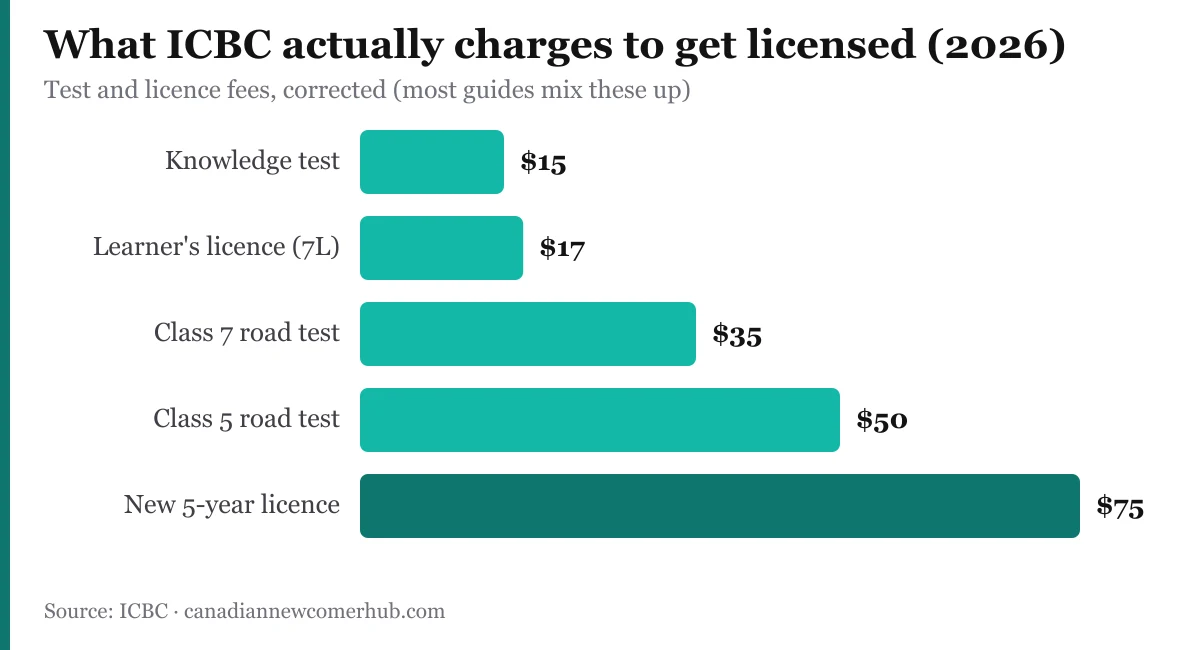
A lot of guides (including the original version of this article) get these numbers wrong by mixing up the test fee with the licence fee. Here's what ICBC actually charges in 2026:
| Step | Fee |
|---|---|
| Knowledge test (each attempt) | $15 |
| First learner's licence (Class 7L), with photo | $17 |
| Class 7 road test | $35 |
| Class 5 road test | $50 |
| New 5-year licence, once you pass | $75 |
The knowledge test is 50 multiple-choice questions based on the Learn to Drive Smart guide; you need 40 correct to pass, and there's a 7-day wait before re-trying if you fail. There's no cap on attempts, but each one costs the fee again — so study first.
Summary: Budget roughly $15 for the knowledge test, $17 for the learner's card, $35 + $50 for the two road tests, and $75 for the licence itself. Failing means paying again, so preparation pays for itself.
How Many Lessons Do You Actually Need?
This depends entirely on where you learned to drive. Driving on the left in the UK or Japan, or in very different traffic cultures, means more adjustment than coming from a system similar to Canada's.
- Similar system, confident driver: 2–4 lessons to learn BC-specific rules and the test route
- Different system, some experience: 5–10 lessons
- Limited experience: 10–20 lessons
- No experience at all: 20–30 lessons (a full GLP course)
Even experienced drivers exchanging into the GLP often take 2–3 lessons just to learn what ICBC examiners look for — the test is as much about demonstrating habits (shoulder checks, full stops) as having them.
How to Choose a Driving School in Metro Vancouver
Rather than chase a "best school" ranking — schools and prices change constantly — judge a school on four things:
- ICBC-licensed instructors. Only licensed driving instructors can prepare you properly; confirm before booking.
- A language you're comfortable in. Metro Vancouver schools commonly offer instruction in Mandarin, Cantonese, Punjabi, Hindi, and Tagalog as well as English — learning road rules in your first language is faster and safer. Ask directly.
- A recognized GLP course, if you're new to driving. A certified course (often around 20+ hours) can also qualify you for an ICBC insurance discount and let you take your road test sooner — worth the higher price if you're a true beginner.
- Transparent pricing. Expect roughly $45–$65 per hour for individual lessons in Metro Vancouver, or $800–$1,500 for a full beginner course. Get the total in writing, including any test-day car rental.
Young Drivers of Canada is the established national chain with multiple Metro Vancouver locations; beyond it, many strong independent and multilingual schools operate across Burnaby, Richmond, Surrey, and Vancouver. Confirm current pricing and instructor languages directly with any school before booking — those details shift, and a quote in writing protects you.
Summary: Pick on instructor licensing, language, a discount-eligible GLP course if you're a beginner, and a written price — not on a ranking. Expect $45–$65/hour or $800–$1,500 for a full course.
Passing the Road Test: Where Newcomers Slip
ICBC examiners fail more road tests over small habits than over big mistakes. The recurring ones:
- Not checking mirrors and shoulder-checking often or visibly enough
- Rolling stops instead of complete stops at stop signs
- Speeding in school and playground zones (30 km/h when lights/signs are active)
- Not scanning intersections before entering
A practical edge: book a mid-morning weekday slot at a less congested testing centre. Lighter traffic gives you fewer variables to manage, and you'll drive more calmly than in rush hour.
Frequently Asked Questions
I'm from Taiwan / Korea / Japan / the US. Do I really skip the tests?
If you hold a full, unrestricted licence and can prove two or more years of driving experience, yes — those are reciprocal jurisdictions, and you can exchange for a BC Class 5 with no knowledge or road test. Bring your licence (and, if you can, a driver's abstract or record showing your experience).
I did exactly this with my Taiwan licence and exchanged it for a full BC Class 5 with no road test — but the step most guides skip is that you have to surrender your Taiwan licence at the Taipei Economic and Cultural Office in Vancouver first to get an official English translation, and they quoted me around two weeks. Only after that could ICBC actually process the exchange. At the counter they asked me a few basic questions out loud, in English, about signs and road rules — nothing hard, just breathe and listen carefully.
How long can I drive on my foreign licence after arriving?
Up to 90 days. After that, your out-of-province licence is no longer valid for driving in BC, so start the exchange or testing process well before then.
What if I have under two years of experience?
You enter the Graduated Licensing Program as a Class 7 driver and test through it. You usually won't start from absolute zero, but you will take the knowledge test and at least one road test.
Does a driving-school course lower my insurance?
A certified GLP course can qualify you for an ICBC discount and may let you test sooner. Ask the school whether their course is ICBC-recognized for that purpose before you pay.
How much should the whole thing cost?
For someone testing through the GLP: roughly $15 (knowledge test) + $17 (learner's card) + $35 + $50 (road tests) + $75 (licence) in ICBC fees, plus lessons at $45–$65/hour or a full course at $800–$1,500. Reciprocal-country exchanges skip the test fees entirely.
References
- Moving to B.C. from outside Canada — ICBC — reciprocal countries and exchange rules
- Driver licensing fees — ICBC — current 2026 test and licence fees
- Book a road test — ICBC — road test booking and requirements
New to BC? The BC Services Card and MSP guide covers your other essential ID and health coverage, and the first-week SIN guide covers the number you need before you can work.